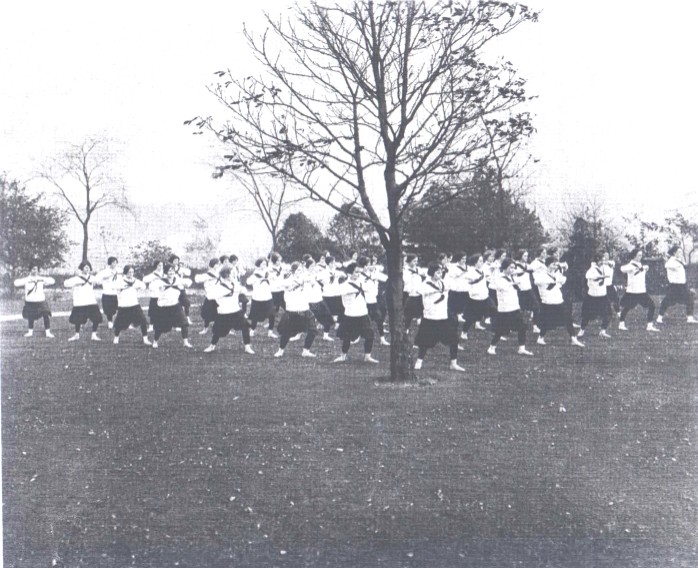
You may have noticed that Lowe Hall is undergoing renovations.
It seems like a fitting time to look back at the history-- and unusual naming!-- of the building. (As usual, transcribed text appears under the clipping images.)
"Looking Back to the Building of Lowe Hall"
It began with a ceremony! But then, Seton Hill, from initiation to commencement, begins and ends ends [sic.] everything ceremoniously. Well "Breaking the Soil" was the first step toward the erection of the new building. It was an impressive rite, typifying progress, hinting of the past great achievements and suggesting future victories.
Then the Steam Shovel arrived. How it dug into the mass of earth, and stone, tearing away the hillside. For days we watched it, at first, fascinated, then fearful, lest the tennis court disappear in a landslide. Then the materials began to arrive. Trucks and wagons, daily traversed the road with their weights of brick and sand and pipes and stone. What noise and hammering and tearing and the building was wel [sic.] underway-
Thus the summer months flew by and the girls were once more back on the Hilltop. The building was yet unfinished.
More pipes, more brick, more supplies. One morning, looking out of the windows, we beheld a car load of bath tubs, which, on account of the rain, were filled with water. You can talk as you please about schools with private roms [sic.] and baths but could you find a number of them so conveniently place [sic.] as under your very window!
Report said, "By Easter, the rooms will be ready." But they weren't. The hammering went on, the noise went on, the constructing went on. We loved it. Everything was so excited and disturbed and extraordinary that our school year was quite an exception to the regular routine.
September came into its own again and with it the new building! Seton Hill had settled down to quiet and peace. Outside of sometimes hearing a little noise and knocking in Lowe Hall, the construction at the present day is modern, cosy and complete.
F. Little, '24.
Most people who have a passing familiarity with the the Sisters of Charity of Seton Hill are aware that Lowe Hall was named for Mother Aloysia Lowe, but most are probably not aware of how it got the name. We have the small but intrepid Class of 1920 to thank for that:


Lowe Hall, so named in honor of Mother Aloysia, was the first of the college residence halls. Ground was blessed and broken for it March 25, 1919, at a ceremony presided over by Father Sullivan, and participated in by the faculty and students. The hall contains more than seventy single rooms. The dining room, attached to Lowe Hall, a fine example of Lombard Gothic architecture, has a seating capacity of five hundred. It was first used by the former pupils of Seton Hill Schools at the annual alumnae banquet, June 17, 1920. In it the Sisters assembled July 19, 1920, to celebrate the Golden Jubilee of their foundation in the Pittsburgh Diocese. A tablet over the fireplace in the dining room, in Old English lettering, pays tribute to Mother Aloysia:
Remember, Good Friends,
Aloysia Lowe
Who as first Mother of her companion
Sisters of Charity in this place
Labored with them in all Meekness,
and with patient striving: who founded
this School of Christian Learning
which still betokens the Worthiness of
her ensemble to her kindred in Faith
& in Honor of whose deeds this
Building is now called
Lowe Hall
In the year 1920 upon the Fiftieth
Anniversary of her First Beginning the
Pennsylvania Mission in the year 1870
--May she and her companions Rest in
Peace & may they Pray for Us.
Hazard--yet forward
MDCCCCXX
For the naming of Lowe Hall the credit, if not the honor, should go to the Class of 1920, Seton Hill College. the three members of this class, the first Liberal Arts graduates of the college, had expected to be the first residents of the new building. Construction operations having been delayed as a result of the war, the girls had been given a half-promise that, since they were obliged to forego the honor of residing in the hall, they should have the privilege of naming it. The privilege, for some reason, was withheld from month to month. The girls clamored for permission to announce the name in The Estonian. The May number, the last before Commencement, was ready for publication and still no permission was forthcoming from the Community authorities.
The students and most of the Sisters felt that this first distinctively college building should be named for Mother Aloysia, the originator of Seton Hill's educational activities. Many members of the Community, however, believed that Mother Aloysia's name should be reserved for a Community building.
The Duquesne Construction Company, the builders, had paid for a full-page advertisement on the back page of The Estonian, which displayed a cut of the hall with the caption, The New Residence Building Seton Hill College, and the name of the builders in inch-high letters. With the approval of the staff adviser, the girls simply pushed the caption down, inserted the name LOWE HALL in conspicuous type, and sent the paper to the printer without more ado. They then acknowledged their temerity to the horrified Dean, who predicted all kinds of dire consequences.
Half triumphant and half apprehensive the class confided their dilemma to Father Sullivan. With his inscrutable smile he remarked, 'All right; now we'll clinch it.' He immediately set about preparing the inscription for the dining room. Soon everyone began to be delighted with the name. In a short time it became generally assumed that the name originated with the building itself.
Here is the infamous ad itself:
And here is a snap of a Lowe dorm room in the 1920's:
As always, many thanks to Bill Black in the Seton Hill Archives for the photos, documents, and stories!


 Secrets of a Charmed Life by Susan Meissner: “Young American scholar Kendra Van Zant, eager to pursue her vision of a perfect life, interviews Isabel McFarland just when the elderly woman is ready to give up secrets about the war that she has kept for decades ... beginning with who she really is. What Kendra receives from Isabel is both a gift and a burden--one that will test her convictions and her heart. 1940s, England. As Hitler wages an unprecedented war against London's civilian population, one million children are evacuated to foster homes in the rural countryside. But even as fifteen-year-old Emmy Downtree and her much younger sister Julia find refuge in a charming Cotswold cottage, Emmy's burning ambition to return to the city and apprentice with a fashion designer pits her against Julia's profound need for her sister's presence. Acting at cross purposes just as the Luftwaffe rains down its terrible destruction, the sisters are cruelly separated, and their lives are transformed…” --Publisher’s summary