Showing posts with label information literacy. Show all posts

Thursday, April 29, 2021

Congratulations to our Research Award winners!


Congratulations to our Research Award Winners! FR/SO: Kathryn Way, for "Melun Diptych Analysis" JR/SR: Jasmine Thomas, for "The Bicultural Social Identity Phenomenon"

CONGRATULATIONS to Kathryn Way and Jasmine Thomas, the winners of the 2021 Reeves Library Research Award!

At the first-year/sophomore level, Kathryn Way won for her paper, "Melun Diptych Analysis." One of our faculty reviewers wrote, "You mentioned how art serves to stir emotion. Your writing did the same!"

At the junior/senior level, Jasmine Thomas's paper, "The Bicultural Social Identity Phenomenon," impressed readers as "a perfect example of how outstanding research can be driven by personal inquiry" and with the way it "stressed the importance of understanding social identity/self concept as not only a way for a person to understand themself, but big picture idea- as a way to understand others."

Competition is always fierce, and we thank everyone who entered or who supported an entry!

Wednesday, February 3, 2021

Reeves Library Research Award accepting entries!

The spring semester has begun, which means that the Reeves Library Research Award is once again accepting entries! 

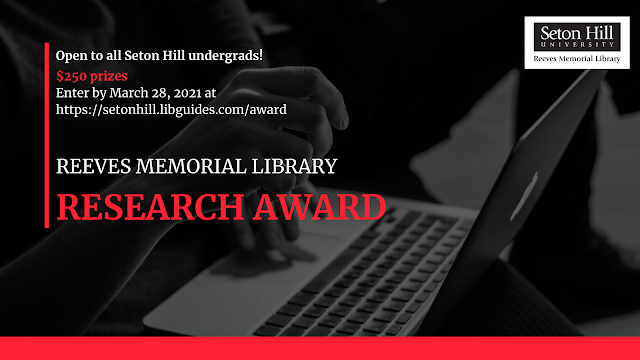
Open to all Seton Hill undergrads! $250 prizes. Enter by March 28, 2021.

For complete details, visit the award page at https://setonhill.libguides.com/award. 


Tuesday, January 24, 2017

Research Award Accepting Applications!

The Reeves Memorial Library Undergraduate Research Award (yes, it's a very long name) is accepting applications!


If you (or one of your students) have created a really impressive research project in the Spring 2016, Fall 2016, or Spring 2017 semester, we want to see it!


The project can be a podcast, a website, a video, a traditional research paper, or whatever other format you can think of, as long as it has a "collection research" component to it (i.e., case studies and lab work don't count, but literature reviews you did as background for them would).


For more information, application instructions, or to volunteer as a faculty evaluator, visit http://setonhill.libguides.com/award.

Wednesday, February 3, 2016

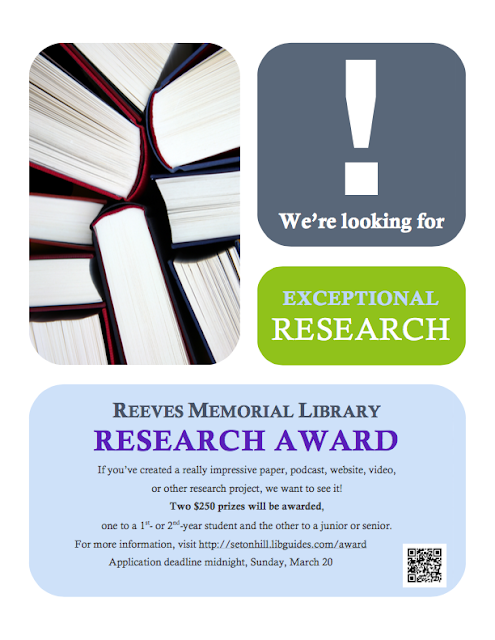
Undergraduate Research Award accepting applications!

The Reeves Memorial Library Undergraduate Research Award (yes, it's a very long name) is accepting applications!
Research Award Flyer

If you (or one of your students) have created a really impressive research project in the Spring 2015, Fall 2015, or Spring 2016 semester, we want to see it! 

The project can be a podcast, a website, a video, a traditional research paper, or whatever other format you can think of, as long as it has a "collection research" component to it (i.e., case studies and lab work don't count, but literature reviews you did as background for them would). 

For more information, application instructions, or to volunteer as a faculty evaluator, visit http://setonhill.libguides.com/award. 


Wednesday, June 17, 2015

If it's too good to be true...

Have you heard that eating chocolate can accelerate your weight-loss program? I have. The finding has been widely reported in all sorts of well-known publications, ranging from Prevention and Shape magazines to Huffington Post and Daily Mail Australia. This was discovered by a team of German researchers who conducted a study and found that those who followed a low-carb diet including a small daily chocolate bar lost weight faster than those following a low-carb diet alone.


The only problem?

It was all a setup.

The lead researcher, Dr. Johannes Bohannon, is actually Dr. John Bohannon. He's a journalist, and his Ph.D. is in the molecular biology of bacteria, not human nutrition. He'll tell you more about how and why he pulled off this huge "gotcha" here: http://io9.com/i-fooled-millions-into-thinking-chocolate-helps-weight-1707251800.

NPR does a good rundown of the whole story and some of the lessons we can take away from it, but let's look at a few factors that even a non-scientist like me could catch if we had looked into the claims a little bit:


  • How many people participated in the study? Only 15 people actually completed this study. As Bohannon points out in his "confession," most scientists will look with suspicion on any study without at least 30 subjects. 
  • How long was the study? This one only lasted three weeks. Has your weight fluctuated a bit in the last three weeks? Mine has. Things like how much you've been sweating recently, how much water you've been drinking, and what point you're at in your menstrual cycle can all affect weight in the short-run.
  • Did the researchers control for age, activity level, gender, or, well, anything? It doesn't seem so.


So, right away, this is a poorly-designed study. Also, there's the small matter of the lead researcher, Dr. Johannes Bohannon, not seeming to have any Google presence at all prior to the publication of this study. That's odd.

So, without knowing very much science at all, and without having even heard of "p-hacking," we could have easily found enough that we COULD understand to be skeptical of these claims.

The problem is that so many busy reporters latched onto the press release without bringing any critical thinking to bear on the study itself. This is one of the reasons that we stress the importance of evaluating sources when we talk about information and research skills. Even a publication with "journal" or "archives" in the title isn't necessarily reliable. And certainly, it seems, we can't rely on frazzled journalists to do our evaluation for us.

Now I want a Hershey bar...

Public domain images from Pixabay.com

Tuesday, April 21, 2015

Reeves Library Undergraduate Research Award winners announced

Congratulations to both of our 2015 winners!

Toni Antonucci was selected as the award-winner for the Junior & Senior division. Her paper, "Effect of BPD Parents on Children: Do Attachment Styles Differ?" impressed the evaluation committee by exhibiting "the top levels of Bloom's Taxonomy in terms of what is created with the research and how it is evaluated." Another panelist wrote, "This well-written research submission begs continuation. I cannot wait to read the study." Ms. Antonucci's entry was sponsored by Dr. Jeff Bartel.

Jordan Penney received the award at the First-Year/Sophomore level for  "Miss-Representation: Exploring the Effects of Media on Body Image in American Girls." Her paper was praised by the evaluation panel for its "mix of source types, with appropriate incorporation of popular sources." Ms. Penney's entry was sponsored by Dr. Brittany Edge.


Thank you to all of the students who entered and to the faculty who sponsored them! We received a number of excellent projects, which made the judging quite a challenge. We hope that those of you who will be at SHU next year will consider entering!

Monday, October 27, 2014

What drips through the filter?

Many of us are aware that our Google searches are tailored to us to a certain extent; what I see when I  google "libraries" probably isn't exactly what you'd see. What we may not have thought about is the extent to which our web experiences are being personalized for us, and what implications that can have on how we understand and interact with the world.

One feature of our online library resources, which we probably don't talk about as much as we should, is that they don't discriminate. If you and I type in exactly the same thing into exactly the same place, JSTOR should show both of us the same data, without trying to guess which articles one of us would "like." It's a more objective, and hopefully more comprehensive, presentation of options.

A good TED talk about the "filter bubble" and how it may be shrinking our world in a not-so-positive way:

http://www.ted.com/talks/eli_pariser_beware_online_filter_bubbles?language=en#t-15046

Thursday, April 17, 2014

Congratulations to our winners!

Competition for the first annual Reeves Library Undergraduate Research Award was fierce, but we are delighted to announce the two winners!

Giannina Gonzalez receives the award for the Junior & Senior division for her project, "Pollution in Beijing." The evaluation panelists were impressed by her "excellent handling of detailed technical information" and "informative, well-written, concise paper" that "is publishable work."

Ashley White was chosen to receive the award at the First-Year & Sophomore level for her work, "The Impact of Fundamentalism on American Women." Panelists noted her "sound development of both the thesis and variations of the content" and appreciated her use of a "wide variety of sources."

Congratulations to both of our award recipients, each of whom will receive a $250 prize in recognition of their work, and thank you to all of the students who entered and to the faculty who sponsored them! We received a number of excellent projects, which made the judging quite a challenge. We hope that those of you who will be at SHU next year will consider entering!

Monday, March 17, 2014

Research Award reminder!

The application deadline for the Undergraduate Research Award is THIS SUNDAY at midnight. Get those entries in and wow us with your research prowess!

There are two $250 prizes up for grabs, so get your research projects in by Sunday night for your shot at riches and glory. 

Monday, February 10, 2014

Undergraduate Research Award

Announcing the Reeves Memorial Library Undergraduate Research Award!


If you're created a really impressive paper, podcast, website, etc., we want to see it. We're awarding two $250 prizes; one will go to a first- or second-year student, and the other to a junior or senior. The application deadline is midnight on Sunday, March 23, and you may enter a project that was created in the Spring 2013, Fall 2013, or Spring 2014 semesters.

For more information and an application, visit http://setonhill.libguides.com/award. 

Wednesday, November 28, 2012

How college students find and use information

Interesting infographic from Project Information Literacy. The study used a small sample size, but it's still something to think about.


Monday, January 30, 2012

“But I Gave Credit”—Copyright infringement /= Plagiarism

In the world of the web, dealing with information and media ethically can be a tangled mess. The issue of copyright and what you are and aren’t allowed to do with other people’s stuff can be especially confusing.

Many people believe that, as long as they give credit to the person or people who created something, it’s okay for them to reproduce it. This is a widely-held belief, especially on college campuses, where we think that “academic fair use” gives us the right to copy stuff if we make it clear that we didn’t create it ourselves.

The thing is that giving credit to the creator of something puts you in the clear as far as plagiarism is concerned, but does nothing at all to protect you from committing copyright infringement.

Why?

Dictionary.com defines “plagiarism” as “the unauthorized use or close imitation of the language and thoughts of another author and the representation of them as one’s own original work…” So by giving the author credit for creating the material, you’re in the clear as far as plagiarism goes. You’re not trying to pass it off as something that you did yourself.

But copyright is concerned about something else—according to dictionary.com again, “the exclusive right to make copies.” Whether or not the author’s name is included with the text or media. If you made a copy of something that wasn’t yours, you are potentially committing copyright infringement.

As educators and students, we do have some special permissions to use stuff for educational purposes, but it’s not a blank check. For instance, you can usually copy a small portion of a book, but you can’t copy nearly half of the chapters. For more information, check out this fun YouTube video from the Copyright Clearance Center.

Tuesday, October 4, 2011

Information Literacy: Real-World Example

I stumbled across a great example of information literacy on Saturday while flipping through the November 2011 issue of Runner's World magazine.


One of the letters to "Ask Miles" was from a reader whose friend is always telling her that running is going to destroy her knees and that his doctor said so.

I loved the response from "Miles."

In a game of your-word-against-someone's-physician, the M.D. is always going to win. So raise the stakes. See his "my doc," and raise him a "peer-reviewed, long-term research and epidemiological study."

He then suggests a couple of studies that indicate distance runners actually have healthier knees than the population at large.

The friend's doctor has some measure of authority when speaking on medical topics, so "Miles" is right about needing to find sources that are even more authoritative if the reader wants to win the argument.

(I'm the second runner, with the navy blue jacket and the red cap!)


Let's try out my favorite test, the EAR check (Expertise, Accuracy, and Reliability), on the studies he suggests.

Expertise: While the friend's doctor knows a lot about the human body, he may be a GP rather than an orthopedic specialist. A peer-reviewed study of the long-term effects of running on knees has likely been conducted (and reviewed) by doctors who have specialized in this particular area of medicine.

Accuracy: Currency is important here. These sources are recent and have not been superseded by later discoveries. The peer-review process helps to ensure that the facts are correct and that there are no glaring omissions or biases at play.

Reliability: These sources are well-documented. The references lists show previous research that has been conducted on the topic and sets these new studies in context. "Miles" has also followed good standard practice here and has suggested two different studies that independently came to the same conclusion.

I think the reader has a good shot at winning the debate with her friend. Hmm, maybe I should send copies of these studies to my well-meaning but worried mom...! =)

P.S. If you're interested in running but find it too intimidating, why not give the super-popular Couch to 5k program a try? With the blessing of your doctor and a decent pair of running shoes, you-- yes, YOU-- could be running a real race just 9 weeks from now!