Wednesday, November 26, 2014

Thanksgiving break hours

Thankgiving Break  
November 25 8:00 a.m. - 4:50 p.m.
November 26 8:00 a.m. - 3:50 p.m.
November 27 - 30 Closed

Have a safe and happy holiday!

Sunday, November 23, 2014

Christmas story time!


It's time for our annual Christmas story time event! All children and their accompanying adults are invited to the Learning Commons main level on Friday, December 5th, from 6:00-7:00 PM. 

The library will provide seasonal snacks, and favorite holiday books will be read aloud.

For more information (or to volunteer as a reader!), email Kelly Clever at clever@setonhill.edu.

Wednesday, November 19, 2014

Citation help drop-ins at the Writing Center

One of our Learning Commons roommate departments, the Writing Center, is hosting citation help drop-in sessions this week!

The Writing Center is offering several hours over the next few weeks for students to drop-in (no appointment necessary!) to ask questions about citations. This week, stop by Reeves 111 between 4:00 pm and 5:00 pm on Thursday, November 20th, for citation assistance. Another drop-in hour will be offered right after break: Monday, December 1st, from 10:15 am to 11:15 am. We can help you finish up those research papers!

Thursday, November 13, 2014

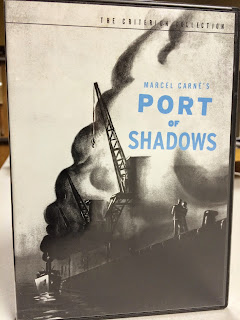
Watch This: Port of Shadows

A bi-weekly series featuring a recommendation of a movie available in the Reeves Memorial Library DVD collection

Port of Shadows (1938)
Directed by Marcel Carné

A truck moves through the foggy night along a tree-lined road outside of Le Havre, France.  The driver peers ahead through the misty darkness.  Suddenly, a lone figure materializes out of the gray fog, a man in a soldier's uniform raising his hand to hail the driver.  The truck comes to a halt, the soldier climbs in, and the truck continues on to Le Havre.  The driver asks the soldier if he's on leave.  The soldier makes no reply.  Further down the road, a dog darts in front of the truck, and the soldier jerks the steering wheel to prevent the truck from running it over.  The driver is enraged at this, and the two men nearly come to blows.

This is the opening scene of the classic French film Port of Shadows (the title sounds better in the original French, Le quai des brumes, but then again, doesn't everything sound better in French?).  The scene is also our introduction to Jean, an army deserter who has come to the busy port of Le Havre looking to find passage on a ship heading for foreign lands, somewhere he can find a new identity and a new life.  Jean is played in the film by the great French leading man Jean Gabin, a man so cool he made Humphrey Bogart seem comparatively square (try not to be impressed by the way Gabin smokes, the cigarette dangling from the corner of his mouth as he speaks around it).  Gabin's unique brand of cool, a toughness of physique and demeanor that is tempered by world-weariness and sentiment, is exemplified in the opening scene in the truck: he cares enough about an unfamiliar dog to risk his own safety to avoid hitting it, but he will just as readily engage in a fistfight with the driver who rebukes him for it.
Jean arrives in town, where he ends up at a ramshackle bar along the waterfront.  There, in a back room, he meets a beautiful young woman with piercing eyes and sharp features.  This is Nelly (Michele Morgan), who seems to be hiding out just like Jean.  Jean says he likes her, and they talk about the difficulties of man-woman relationships.  Meanwhile, in a local nightclub, we see the gangster Lucien (Pierre Brasseur) pressuring shop owner Zabel (Michel Simon) to tell him the whereabouts of a local hood named Maurice.  Zabel, it turns out, is 17 year-old Nelly's legal guardian, and Maurice was her boyfriend.  Zabel knows Lucien is all bark and no bite, and says he doesn't know where Maurice is.  Later, after the sun has risen, Lucien spots Nelly and Jean talking together near the docks, and he stops and asks her about Maurice.  There is a confrontation between Jean and Lucien which results in the ineffectual Lucien being slapped repeatedly across the face.  Lucien, enraged and humiliated, leaves with his men, and Jean and Nelly part ways, agreeing to meet later.

Nelly returns to Zabel's shop, where Zabel makes physical advances toward her, shedding light on her reasons for hiding out.  After inquiring about departing ships at the docks, Jean finds his way by chance to Zabel's shop, looking to purchase a gift for Nelly.  Zabel invites him in, and quickly figures out that Jean is a deserter, although he hints that he will keep Jean's secret if Jean will get rid of Lucien for him.  Jean blows him off with an insult, comparing him to a bug.  Nelly goes to the cellar to get a bottle of cognac, where she discovers a familiar pair of cuff links on the floor beneath the stairs.  It is clear that they belonged to Maurice, and Nelly immediately suspects Zabel of foul play in his disappearance.

Things begin to look up for Jean.  Fortuitous circumstances bring him a set of civilian clothes and new identification papers, and he befriends the doctor on a ship setting sail for Venezuela the next day.  He meets Nelly at a small carnival by the docks later that evening, and their feelings for one another grow.  There is another altercation with Lucien at the bumper cars, and he is again humiliated, this time in front of his date.  Jean and Nelly spend the night together at a waterfront hotel, and the next morning she says that this is first time she has ever felt she could live a happy life.  Their bliss is interrupted by the news that Maurice's mutilated body has been found at the docks, and that a soldier is the main suspect (Jean's discarded army uniform was also found in the water).  Jean breaks the bad news, that he must leave that afternoon aboard the Venezuela-bound ship, although he is clearly reluctant to do so.  Whether he chooses to stay with Nelly or not, his plans are threatened by the machinations of the jealous Zabel and the vengeful Lucien.

Port of Shadows was one of the defining films of a movement known as "poetic realism," which dominated French cinema in the late 1930s.  One of the prime characteristics of the movement was its emphasis on fate, and from the fog-enshrouded opening images of Port of Shadows, there is the sense that everything that happens was destined to lead Jean and Nelly down a tragic path.  The sense of impending doom that hangs over the film is so compelling, it is hardly spoiling the plot to say that things don't end happily.

It is a beautiful and moving film, with a script by Jacques PrĂ©vert that infuses the tragic fatalism and criminal milieu with lyrical flourishes.  "With every sunrise," says Nelly, "we think something new is going to happen, something fresh.  Then the sun goes to bed, and so do we.  It's sad."  The film's use of music and sound is also noteworthy.  During Jean and Lucien's confrontation at the bumper cars, the cheerful carnival midway music acts as a counterpoint to the sudden tension and sense of impending violence.  In a later scene, another act of violence plays out to the sound of a choral hymn coming from a radio in the next room.  And always, in the background, there is the sound of the docks and of ships' whistles blowing, a constant reminder of Jean's imminent departure.

Monday, November 3, 2014

November DVD Spotlight: French Cinema

This month, come along on a cinematic journey to France, the land of wine, cheese, and some of the best films of all time.  If comedy is your thing, check out the playful visual humor of Jacques Tati in Playtime (1967).  If you enjoy gangster films, you'll like incomparable tough guy Jean Gabin in Touchez Pas au Grisbi (1954).  Looking for a love story?  Everything sounds more romantic in French.

We've got contemporary classics and landmarks of the French New Wave, such as:

The 400 Blows (1959)
L'Atalante (1934)
Beauty and the Beast (1946)
The City of Lost Children (1995)
Diabolique (1955)
Grand Illusion (1937)
Jules and Jim (1962)
The Triplets of Belleville (2003)

Check one out today.  Ce sont formidables!

Thursday, October 30, 2014

Watch This: The War Room

A bi-weekly series featuring a recommendation of a movie available in the Reeves Memorial Library DVD collection

The War Room (1993)
Directed by Chris Hegedus and D.A. Pennebaker

With midterm elections coming up next week, many Americans are no doubt looking forward to being able to fulfill their civic duty by casting their votes for the candidate of their choice.  For many, this will also mean a much anticipated slackening in the onslaught of personal attacks targeted at said candidates.  With the 24-hour news cycle and ubiquitous social media feeding these attack campaigns, and what seems like a growing gap between politicians and the citizens they are supposed to represent, it's difficult not to become overwhelmed by the negativity and cynicism, and to forget that there was a time when local and national elections brought with them a sense of hope for positive change.  One such instance was the presidential election of 1992, when Arkansas governor Bill Clinton emerged as the Democratic frontrunner in opposition to Republican incumbent George H.W. Bush.  Clinton was elected in a landslide victory as the first Democratic president in almost a generation, and much of his victory can be attributed to the work of his campaign staff, who helped Clinton overcome a sex scandal and galvanized record numbers of young voters.  This unconventional, game-changing campaign was chronicled by filmmakers Chris Hegedus and D.A. Pennebaker in their revealing and entertaining behind-closed-doors documentary, The War Room.

When Hegedus and Pennebaker initially set out to document Clinton's campaign, they were denied access to the candidate himself.  Consequently, they turned their focus to Clinton's chief campaign strategists, Campaign Manager James Carville and Director of Communications George Stephanopoulos.  One could easily argue that the lack of access to Clinton was fortuitous, because the resulting film is a compelling, buddy comedy-like portrait of two opposites, brought together by their shared idealism and belief in their cause.  Carville, nicknamed the "Ragin' Cajun," emerges as the film's real star, a charismatic, passionate, inspiring, witty, and sometimes profane strategist whose incisive dissection of key issues ("The economy, stupid!") keeps the staff focused.  Stephanopoulos is equally passionate and brilliant, but his comparatively low-keyed manner makes him a natural foil to the outspoken Carville.

As the film opens in the days leading up to the New Hampshire primary, Clinton is still one of many Democratic candidates, and we see the local campaign staff dealing with torn-down signs.  After Clinton has emerged as the frontrunner and added Al Gore as his Vice-Presidential candidate, we see the team debating about sign colors for the Democratic Convention.  Later, there is a heated discussion about the wording of a TV spot.  We see Carville bemoaning what he sees as the press's unbalanced coverage of the two candidates after Bush mentions Clinton's alleged draft-dodging.  "Every time somebody farts the word 'draft,' it's on the front page of the paper," says Carville, and he wants to know why there are so few stories about Bush's broken election year promise ("Read my lips: no new taxes").

Much of the footage seen in the latter half of the film was shot at Clinton's national campaign headquarters, nicknamed the "war room," and there is a sense for the viewer of eavesdropping on the campaign proceedings, a feeling that you are there in the room during these moments in history.  The film employs none of the direct interviews with participants and voice-over narratives that have come to dominate the mainstream documentary style over the past two decades.  Pennebaker and Hegedus, true to their roots in the "direct cinema" movement that began in the 1960s, sought to capture these events as they were happening, with no rehearsal or staging, and the result truly is a feeling of "being there."  This aesthetic lends the film an immediacy and tension that make it easy to forget that we know going in what the result of the election is.  Clinton wins, of course, but this film is not about the result, it's about the process that led to that result.

More than anything, what comes through in these captured moments is a feeling of optimism and pride from Clinton's campaign staff.  On the eve of the election, with Clinton a clear leader in the polls, Stephanopoulos is seen praising Carville and the rest of the team, stating that after the next day people will have better jobs, pay less for healthcare, get better healthcare, and their children will go to better schools.  He is later captured saying that this campaign is the best thing he ever did.  A choked-up Carville can also be seen talking about how they changed the way campaigns are run, and he makes it clear throughout the film how important it is for them to win, not just for Clinton, but for the impact his victory would have on the field of campaign strategy.  It is apparent from these scenes that these feelings are sincere, that it's not just a performance.  They truly believe that Clinton is the best man for the job.

The film is particularly interesting to watch from a contemporary perspective, as subsequent years have shed new light on the allegations of marital infidelity that threatened to derail the Clinton campaign even before the primaries.  Clinton is seen denying the affair with Gennifer Flowers to the press, and key members of his campaign team make it clear that they believe in his innocence regarding these matters.  Clinton, of course, later admitted to a sexual encounter with Flowers.  It's also fascinating to see that many of the key points in Clinton's campaign platform (ending the recession, job growth, universal healthcare, and education reform) are still key issues over twenty years later.

Monday, October 27, 2014

What drips through the filter?

Many of us are aware that our Google searches are tailored to us to a certain extent; what I see when I  google "libraries" probably isn't exactly what you'd see. What we may not have thought about is the extent to which our web experiences are being personalized for us, and what implications that can have on how we understand and interact with the world.

One feature of our online library resources, which we probably don't talk about as much as we should, is that they don't discriminate. If you and I type in exactly the same thing into exactly the same place, JSTOR should show both of us the same data, without trying to guess which articles one of us would "like." It's a more objective, and hopefully more comprehensive, presentation of options.

A good TED talk about the "filter bubble" and how it may be shrinking our world in a not-so-positive way:

http://www.ted.com/talks/eli_pariser_beware_online_filter_bubbles?language=en#t-15046