Friday, May 17, 2024

Summer Library Newsletter

 The Reeves Memorial Library Summer 2024 newsletter is live!

decorative

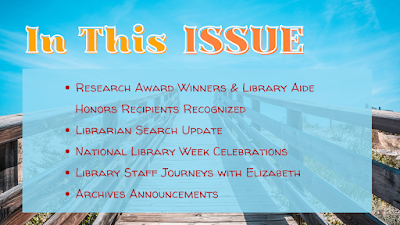
In this issue:

  • Research Award Winners & Library Aide Honors Recipients Recognized 
  • Librarian Search Update
  • National Library Week Celebrations
  • Library Staff Journeys with Elizabeth
  • Archives Announcements

Tuesday, May 7, 2024

Finals Week Hours

It's finals week!

The Library (the staff office and the rooms with the books) will be open the following hours this week; the Learning Commons space is separate from the Library and its hours are not expected to change.

Tuesday, May 7: 8:00 a.m. - 9:50 p.m.

Wednesday & Thursday, May 8 & 9: 8:00 a.m. - 7:50 p.m.

Friday, May 10: 8:00 a.m. - 4:50 p.m.

CLOSED on Saturday & Sunday, May 11 & 12

Good luck to everyone on their exams and final projects, and a huge CONGRATULATIONS to the graduating students!


Friday, April 26, 2024

Friday Reads: Rites of Spring: The Great War and the Birth of the Modern Age

Happy Friday! This week, Interim Library Director Adam Pellman tells us about his current read, a nonfiction book about the era of World War I called Rites of Spring: The Great War and the Birth of the Modern Age by Modris Eksteins. 

Adam holding a paperback copy of Rites of Spring by Modris Eksteins


It's always seemed to me that World War I has been overshadowed in American cultural memory by World War II. This is perhaps not surprising, given that our involvement in World War I was comparatively much shorter, and that, as time has gone by, veterans of World War II have been far more visible and celebrated in our culture as the "greatest generation." So I've been finding myself drawn more and more in recent years to books and films about World War I. This book distinguishes itself in that it's not a work of military history, but rather cultural history. It is a book about, as the author writes in the preface, "the emergence, in the first half of [the 20th] century, of our modern consciousness ... For our preoccupation with speed, newness, transience, and inwardness -- with life lived, as the jargon puts it, 'in the fast lane' -- to have taken hold, an entire scale of values and beliefs had to yield pride of place, and the Great War was ... the single most significant event in that development."

I'm only about halfway through the book, so the author is still focused on the events of the war itself, but he's already made some illuminating points. For example, he writes about the well-known Christmas truce that broke out along many parts of the western front in December of 1914, only a few months after the war began, when enemy soldiers openly fraternized, sharing food and drink and exchanging goods in a spirit of brotherhood and peace. Eksteins argues that such a widespread occurrence would have been unthinkable only a few years later, closer to the end of the war, as the shared values and "rules of war" (spoken or unspoken) had already changed so drastically. By 1917, this war, with its trenches and horrible new weapons, had become something new and different in the history of warfare. Eksteins attributes this change to Germany's initiative in altering the "methods, tactics, and instruments of war," and its position as the revolutionary power of Europe, with its willingness to "question western social, cultural, and political norms" even before the war began. "What was important above all for Germans," writes Eksteins, "was the overthrow of the old structures. That was the whole point of the war." He contrasts this with the British, whose more conservative aim in fighting the war was to restore and preserve their place as the dominant nation in western Europe, to retain the status quo. It's an interesting way to look at a country's military aims, not in relation to politics, or territory won or lost, but in relation to values. I'm looking forward to the rest of the book, to see how the author examines the war's influence on not just social and political developments, but also on literature and the arts.

Friday, April 12, 2024

Friday Reads, Special National Library Week Video Edition: Emily's Runaway Imagination

 Happy Friday, Happy National Library Week, and Happy D.E.A.R. (Drop Everything And Read) Day! This week's Friday Reads is a special video book talk about the origins of D.E.A.R. Day and of Kelly's favorite Beverly Cleary book, Emily's Runaway Imagination


Sunday, April 7, 2024

National Library Week April 7-13 2024

National Library Week is an annual celebration sponsored by the American Library Association (ALA). It has been observed throughout the United States every April since 1958! The week highlights the many ways libraries, librarians, and library workers transform lives and strengthen school, public, academic, and special-interest communities.

The theme for that first National Library Week in 1958 was "Wake Up and Read!" This year, for the 66th celebration, the theme is “Ready, Set, Library!"


Ready Set Library! National Library Week April 7-13, 2024


Throughout the week, stop by Reeves Hall and visit the Reeves Memorial Library spaces upstairs and downstairs for research help, interactive whiteboard questions, bookmark and sticker giveaways, and easy ways to express your support for the Library, its staff, and its resources. And make sure to participate on social media by following us on Instagram, Twitter, and Facebook.

National Library Week Events:

Monday-Friday, all day: Daily themed displays, bookmark giveaways, and a collaborative art project (by the Library desk on the main level of the Learning Commons)

Monday (Right to Read Day): ALA releases the State of America's Libraries report and the Top Ten Frequently Challenged Books of 2023, which we’ll share by our main desk and on our social media

Tuesday (National Library Workers Day): Library Aide appreciation day - thank a student Library worker

Wednesday (National Library Outreach Day): Stop by the display board for fun library trivia and to learn about the public libraries serving our region

Thursday (Take Action for Libraries Day): Post on our Padlet to let us know how the library advances your teaching, learning, and/or scholarship

Friday (Drop Everything And Read, or DEAR Day): In honor of Beverly Cleary, we’ll host a virtual book talk about one of her lesser-known books, and the first two people to find a library mouse will each win a USB book light

Friday, March 1, 2024

Spring break hours


decorative

The Library will be closed March 2-3, open 8:00 a.m. - 4:50 p.m. March 4-8, and closed March 9-10 for spring break. Normal term hours will resume on Monday, March 11th. Have a safe and happy spring break!

Friday, February 23, 2024

Friday Reads: Normal People

Happy Friday, Griffins and friends! Interim Director Adam Pellman is reading a once-buzzy and once-new novel, Normal People by Sally Rooney. Read on for his thoughts!


Adam holding a hardcover copy of Normal People by Sally Rooney

I'm in an online book club that's themed around movies and TV. We alternate each month between nonfiction books that are about movies and TV, and fiction books that have been adapted into movies and/or TV series. This month, the selection was Sally Rooney's Normal People, a novel that received a lot of buzz when it was published, and was made into a limited series a few years back. This is the perfect time for me to read it, as I have a tendency to read buzzy new novels years after they've stopped being buzzy or new.

The novel follows Marianne and Connell, both from the same small town in Ireland, who forge a strong, short-lived, and very secret relationship in high school, then meet again the following year in Dublin, where they both attend Trinity College. They drift in and out of each other's romantic lives, always drawn magnetically back to one another. I'm about halfway through the book right now, and their increasingly self-destructive behaviors give me the growing sense that deep troubles lie ahead.

Stylistically, this book is different from anything I've read in quite some time. For one thing, Rooney writes her dialogue without any quotation marks, like Cormac McCarthy or Bryan Washington. For another, her prose is very spare. I'm usually a sucker for lush, descriptive language, but this novel doesn't have that. I think it's one of the things that lends the novel such a powerful sense of intimacy. It's almost like the stripped down prose strips away the barrier between me and the characters. It's a 180-degree turn from the last novel I read, a big, sprawling sci-fi epic.