Friday, October 28, 2022

Friday Reads: The Year of Living Danishly

Happy Friday! And if you're looking for ways to make all of your days a bit happier, Kelly's current read, The Year of Living Danishly by Helen Russell, attempts to dissect the contributing factors to Denmark's famed happiness. 

Kelly with a Kobo e-reader displaying The Year of Living Danishly


I don't remember what caught my attention about this book, but it was evidently enough that I downloaded it from the public library. I enjoy learning about different cultures through the eyes of long-term visitors, and the writer of this book (Helen Russell) is a London native who moved to a remote area of Denmark for a year so her husband could pursue a dream opportunity at Lego. As a freelance lifestyle writer, she knew that Denmark regularly ranks as the world's happiest nation, and she wanted to take an up-close look at the aspects of Danish life that contribute to this contentment. 

The author's time in Denmark begins, inauspiciously, in January. Russell is horrified by the "baltic" temperatures, which made me feel smug after I converted the numbers to Fahrenheit. The Danish are all holed up at home with their families and friends at this time of year, doing hygge things. She and her husband gradually learn more about their adopted land, furnish their rented home, and have an unfortunate run-in with the neighbors over recycling protocols. 

Russell terms her year in Denmark her "Danish happiness project." Though I don't think she references it by title, this book is clearly inspired by and patterned after Gretchen Rubin's The Happiness Project. Each month of her year is devoted to learning about and experimenting with one particular aspect of Danish life and culture. January, for instance, delves into the concept of hygge and the impact of interior design. In February, she looks at corporate cultures and workplace expectations. In March, she explores the importance Danes place on being involved in clubs. 

I doubt this book is going to be lifechanging for most, but it's an easy read and gives a glimpse into life in a country most of us probably know little about. 

Friday, October 21, 2022

Friday Reads: Pachinko


It's been a minute since our last Friday Reads post, but we haven't forgotten! Today, Adam tells us about Pachinko by Min Jin Lee and reflects on learning through historical fiction. 


One of the things I like about reading historical fiction, especially historical fiction written by authors from other parts of the world, is that I often learn for the first time about historical events that occurred outside of the United States. Before I started reading Pachinko, by Min Jin Lee, I never knew that Korea was a Japanese colony from 1910 until the end of World War II. To learn that Korea was not an independent nation for most of the first half of the twentieth century came as a surprise to me, and it helped spark my interest in this story right from the start.

Pachinko is a sprawling, multigenerational saga about a Korean family's experiences living in Japan during the twentieth century, exiled from their homeland and struggling to survive and thrive amid prejudice, hardship, and loss. The story begins with teenage Sunja, who becomes pregnant after falling for a wealthy businessman in her seaside Korean village. Refusing his offers of financial support after finding out he's already married, she instead accepts an offer of marriage from a kind minister passing through on his way to Osaka. Sunja moves to Japan to live with the minister and his family, and so begins an immigrant story that is rich with themes of sacrifice, ambition, and love. I'm usually a sucker for flowery or elaborate language in the fiction I read, but Pachinko is written in simple, straightforward prose that is nevertheless very affecting.

Friday, August 5, 2022

Friday Reads: War and Peace

Happy Friday! Let's all help Adam celebrate a significant undertaking -- the reading of a classic that everyone has heard of and most of us have not read (at least not entirely). This week, he tells us about Leo Tolstoy's opus, War and Peace. 

Adam with a large copy of War and Peace


It's hard to remember a time before I started reading this book.

Just kidding! War and Peace has a reputation as one of the longest novels ever written, and it turns out that reputation is well deserved. The edition I'm reading is 1,215 pages, plus an introduction (which I did read) and other supplementary material (which I won't read). I'm pleased to say, though, that despite its length, War and Peace is a fantastic read, and far more accessible than other Russian fiction that I've read, such as The Brothers Karamazov. Grand in its storytelling ambitions, and truly sweeping in scope, War and Peace focuses primarily on the lives of members of two noble Russian families, the Rostovs and the Bolkonskys, during the Napoleonic Wars. The extensive cast of characters even includes Napoleon himself. It's an interesting historical novel in that, while most of the chapters are written from a standard third-person point of view, Tolstoy will sometimes interrupt this flow with commentary about how later historians incorrectly described or misinterpreted a certain event or military decision.

One of the things that I appreciate about this particular edition, which is a more recent translation by Richard Pevear and Larissa Volokhonsky, is that it includes a wonderful introduction by Pevear. Not only does it provide background about Tolstoy and the novel, but it also includes some comments about the translation itself. Pevear and Volokhonsky made it their mission not just to provide a translation in terms of the meanings of individual words and phrases, but also to try and preserve Tolstoy's writing style as much as possible. I feel like they were successful. I get a real sense of the author's style and voice in reading this novel, and it's given me a deep appreciation for the skills that a talented translator can bring to the table.

It makes me glad that I opted for this newer edition. In retrospect, though, an ebook may have been a wiser choice. This thing weighs a ton.

Friday, July 22, 2022

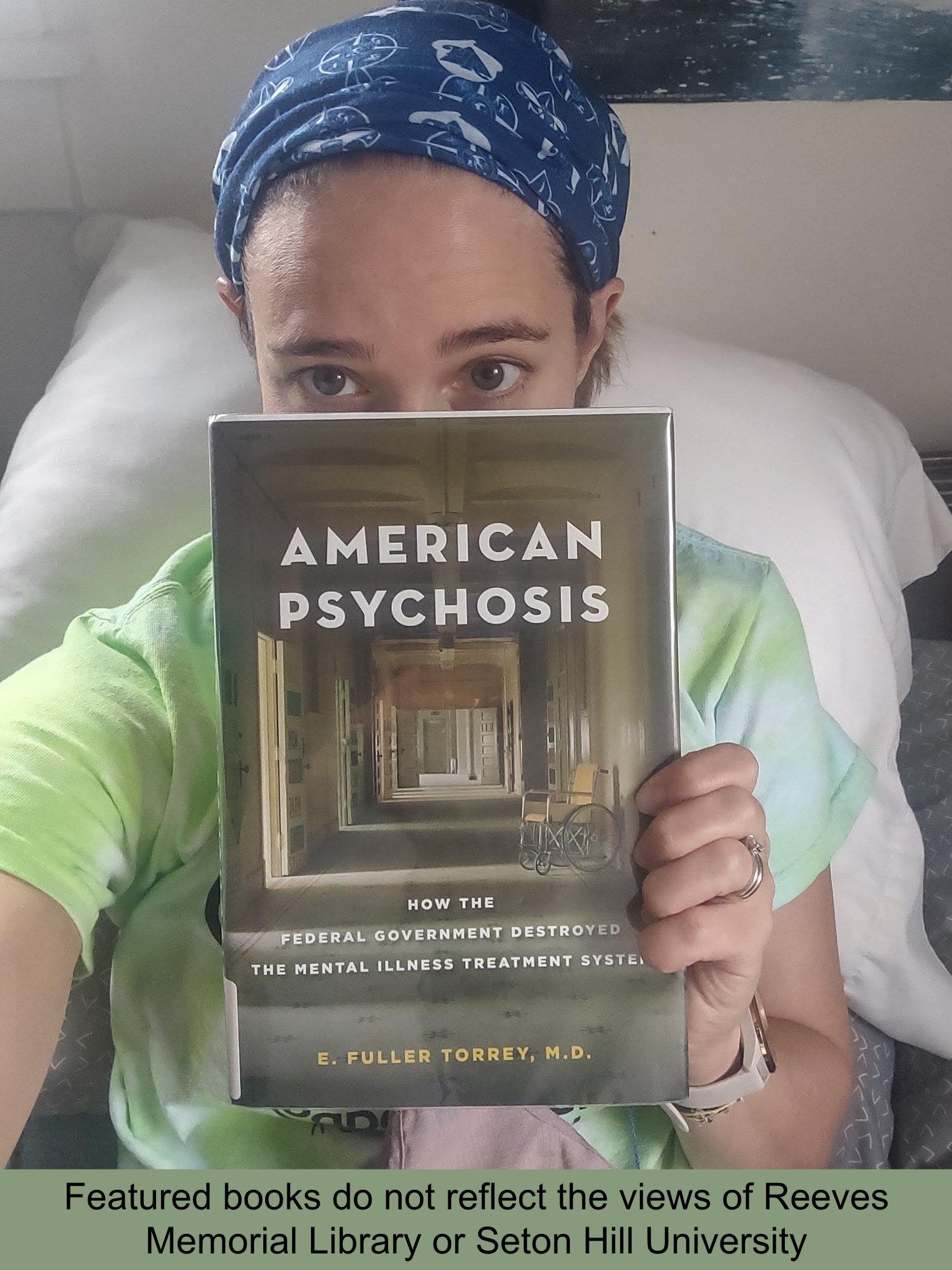
Friday Reads: American Psychosis

This week's Friday Reads is a Covid edition; Kelly finally succumbed to the virus and had a bit more time to read than usual. This week she tells us about American Psychosis: How the Federal Government Destroyed the Mental Illness Treatment System by E. Fuller Torrey.


For various reasons, I've had an interest for years in how the United States cares for (or does not care for) people with severe mental illness. On a visit to the Trans-Allegheny Lunatic Asylum in Weston, WV on vacation years ago, I was impressed with how much historical information was presented in their small museum area and at how compassionate the guides were when speaking of the former patients. We also learned a great deal about how the closure of the hospital in the '90s impacted the surrounding community as well as the former inhabitants and staff. 

American Psychosis explains how America went from an all-time high number of mental illness inpatients in the 1950s to our current situation, where often people with severe mental illness are shuttled from the streets to the emergency room or jail and back again. 

Well-intentioned figures such as JFK and Robert Felix (the first director of the National Institute of Mental Health - NIMH) set in motion a program that would close the hospitals in favor of community treatment. Torrey, who worked at NIMH as the changes were taking place, contends that the community treatment centers were incentivized to focus on community "wellness" measures rather than on treating discharged people with severe illnesses such as schizophrenia or bipolar disorder.

Torrey traces the changes of the mental health program from the 1960s to the 2010s, showing how funding sources were shifted, resulting in less oversight and coordination of care and allowing huge numbers of people to fall through the cracks. He considers the legal "right to be insane" and how this can harm both the individuals with severe mental illness and those in their communities. He examines the abuses and neglect that take place in many community living arrangements for people with mental illnesses. Finally, he presents suggestions for steps that could be tested and/or implemented to improve the quality of life for people with mental illness and the community as a whole. 

Nobody wants to go back to a time when someone could be institutionalized against their will for a vague diagnosis like "hysteria," but it is clear that much suffering has been shifted from the hospital ward to the jail cell or park bench rather than eliminated. I was particularly taken with a quote on page 125: "Our failure to protect such mentally ill people by ensuring that they receive treatment is a major miscarriage of our medical care system and a blot on our claims to be civilized." 

Friday, July 8, 2022

ALA in DC

Well, enough time has passed to allow me to come down from my "high" of attending this years American Library Association Annual Conference in Washington, D.C. It's always amazing to see the latest innovations in all things library. Sort of made my mouth water! 


It was also nice to meet many of my vendors so I could put faces with some of the people I speak with quite often and have some discussions about their products. 


I heard John Cho being interviewed about his new book, "Troublemaker." It was amusing when the interviewer had a coughing spell and John Cho said with a couple hundred librarians in the room someone has to have a Ricola--of course quite a few made their way to the stage. 


And, of course, the best part of the trip was meeting Dr. Carla Hayden, the Librarian of Congress. She was a professor at Pitt's library school when I attended but her classes were the most difficult to get into. 


So all in all it was reminiscent of looking through the Sears Christmas Catalog of my youth. Well see what Santa brings me this year!


Thursday, July 7, 2022

New copyright small-claims "court"

 Recent legislation has instituted a new "small claims" board, or semi-official court, for copyright infringement issues. The Copyright Claims Board falls under the umbrella of the Copyright Office rather than in the judiciary branch of the federal government. 

The Electronic Frontier Foundation presents an overview of what this new body is and why, for many defendants, declining to have the case managed by the CCB in favor of the traditional route through the federal courts may be a smart move. Read more here: https://www.eff.org/deeplinks/2022/06/copyright-small-claims-quasi-court-opens-heres-why-many-defendants-will-opt-out 

Friday, June 24, 2022

Friday Reads: The Second Amendment; A Biography

Happy summer Friday (and aren't summer Fridays the very best kind?)! This week, Adam tells us about a recent read from his ongoing Dewey Decimal Reading Challenge -- The Second Amendment: A Biography by Michael Waldman.


The Second Amendment has been the subject of much debate in recent years. This book, rather than being about guns or gun control, is a constitutional and legal history of the controversial and often misunderstood amendment. Waldman devotes the first part of the book to the historical context of the American Revolution and the drafting of the Constitution and Bill of Rights, revealing much of what we know (and don't know) about the Framers' thoughts and intentions around this provision, most of which were focused on the need to maintain armed militias. Waldman also shows how judicial decisions and political advocacy have, over the past two hundred years, transformed a relatively obscure and minor constitutional amendment into one of the most fiercely-debated legal topics of the current moment. The book offers an eye-opening history that reveals how much our country has changed since its founding, and how our views on individual rights and civic duty have evolved over the decades.